
Escaping a Jordan Escape
People travel to be immersed in a world different than theirs at home. To be open and free. To discover. To feel connected. To escape everyday life. I had traveled to Jordan for all of this, but on a highway, somewhere between Amman and Aqaba, I felt the need to make an escape within the escape.
Escape #1
The van deposited us at a rest stop for tourists — a building the size of a North American grocery store packed with kitschy, mass-produced souvenirs, a canteen, and toilets. Tourists from all parts of the planet streamed into the box-like structure from long tour buses neatly lined up in the parking lot. I was embarrassed to be there, as though someone I knew may drive by and spot me, someone from home over 10,000 kilometres away. This was not the Jordan I came to see.
After a quick pee (the restrooms being the only appeal here), I stood outside in the February sun, scanning my options. I had just seventeen minutes before the van would resume its journey south. What could I see authentic to Jordan on a stretch of highway?
I started walking, and soon found Tafaga Café, a shack supported by metal scaffolding, selling coffee and shisha and snacks for the road.
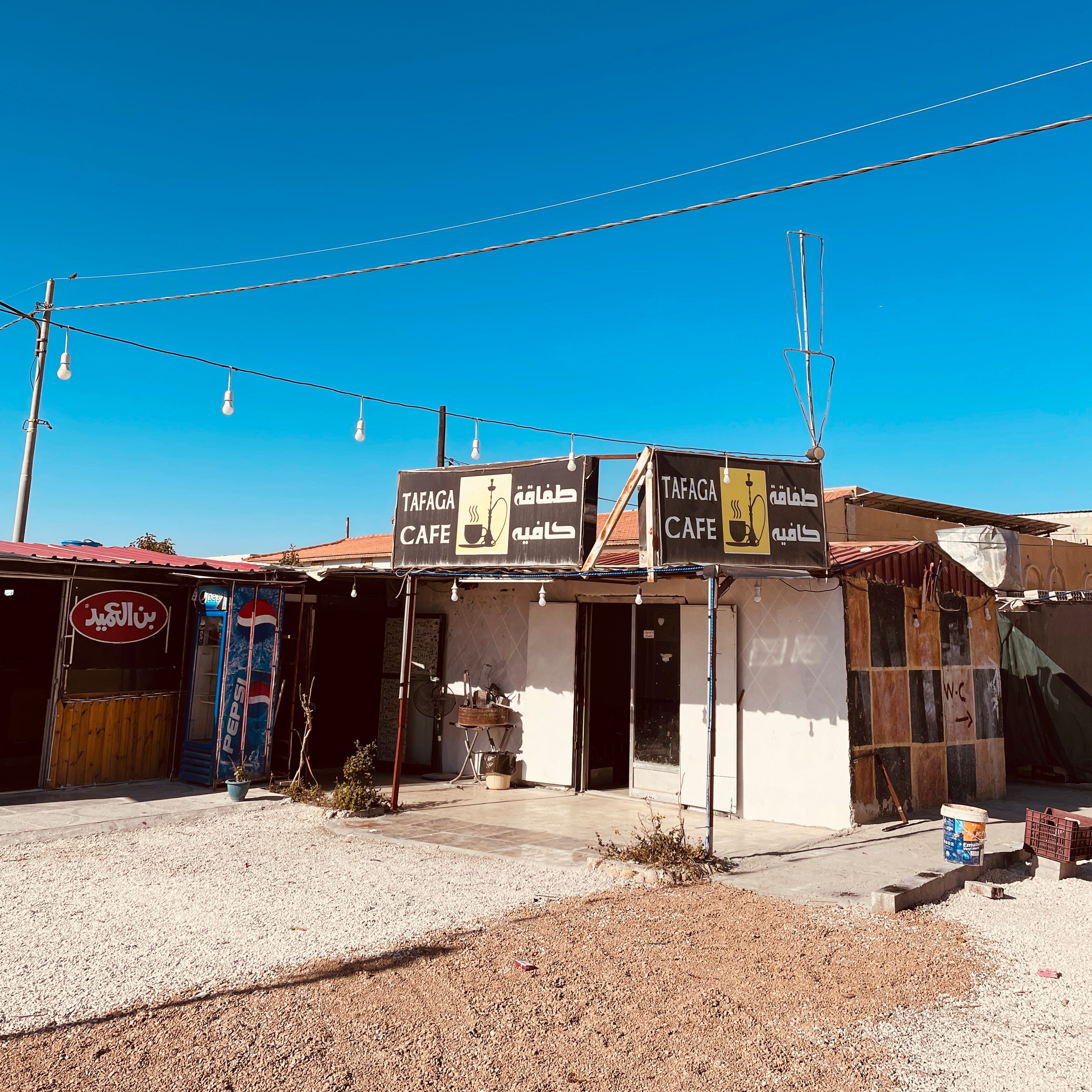
The man behind the counter made me a black tea, and I took it outside to the small courtyard, where two Jordanian men were sitting on plastic chairs around a large shisha. One motioned me to sit with them. This is what I wanted, wasn’t it? To mingle with the locals? I joined them. They spoke minimal English, and I speak zero Arabic, but we managed to connect the way humans do. Smiles, hand motions, head nods. One of them showed me pictures of family members living in Canada as though I may have passed or will pass them on the street. They offered me an inhale from the shisha pipe.
This was my first visit to the Middle East. I was there to see Petra, a place I’d dreamed of visiting since I was a young girl. It was Indiana Jones who started the dream, as he galloped from the ancient Treasury through the narrow and winding Siq, on to his next adventure.
I was happy to do this trip alone. Actually, I preferred it. I enjoy the freedom, the absence of compromise, the solitude. I struggle being present in a place when in the company of others.
But I was apprehensive about traveling alone in Jordan. For someone aching for an adventure, I chose the least adventurous route — an eight-day group tour — believing it would be the easiest and safest way to get around and see a country so foreign to me. I thought I would have plenty of opportunities to assert my independence, that I could eat at a table for one with my notebook beside my plate, that I wouldn’t have to integrate with a group if I didn’t want to.
When we arrived in Aqaba at lunchtime, we gathered in a strip-mall restaurant catering to foreigners. I sat in the centre of a long table, shackled to small talk and limp French fries, aching to wander, to eat a shawarma, or to be anywhere but here. A lump grew in my throat and I prayed the tears would stay inside.
I was lonely yet surrounded by people. It’s possible to feel the greatest pangs of loneliness when not actually alone, when a sense of connection is absent in the people you’re with.
There should be a box you can check when signing up for a group tour: Prefers to Eat and Explore Alone, No Offense.
After lunch, our guide led our group of ten through the streets on an out-of-the-way route towards the Red Sea. He promised us time to ourselves once we got there. We stopped at a pharmacy for twenty minutes so someone could buy cold medicine. We stopped at souvenir stands so someone else could browse. Each time, I stood on the sidewalk fuming silently, wanting to assert my frustration. They were eating into my time to be free.
Finally, at the water, we were allowed to disperse, to be alone.
Allowed.
I felt like a schoolgirl allowed twenty minutes of play at recess, dreading the bell signaling a return to class.
From Aqaba, we drove to Wadi Rum, to a camp in the desert where we would sleep in huts framed in wood, with walls made of a thick camel-hair cloth. windowless except for a small, square portion of wall that slid open to reveal the elements. No internet. Electricity only available in the large dining tent. Isolation in a vastness of reds and oranges and browns.
The Bedouins hosting us cooked a feast of meat and vegetables in a hole dug into the sand, a traditional process known as zarb. There was nowhere to eat but together, with my fellow travelers. I struggled to be in the moment, to taste the delicious food, to absorb the experience. The air was stifling with small talk and grumblings about the lack of food options and chit chat about things from home — home being England, America, and Australia.
What was wrong with me? That was my immediate thought — that there must be a problem with me because I wasn’t like them, because I didn’t fit, because of my discomfort. I felt rude and elitist. I felt antisocial and deficient. I felt this was indicative of a bigger issue — I was simply not meant to be around people and I would be alone forever. The stories spun a web in my head.
Instead of connecting with the land, I was disconnecting with who I was, questioning my very being.
I cried myself to sleep in my tent, snuggly wrapped in my sleeping bag, scarf circled around my head for warmth, the chill of the desert’s night seeping into my layers. I kept the sliding portal open despite the cold, wanting to, at least, feel connected with the stars.
Escape #2
I awoke with locked hips, and a pain that zipped down my left leg into the arch of my foot. It was excruciating to walk. And it was a familiar injury that I’d neglected to care for.
The 25,000 steps I had walked on each of my three days in Amman before the tour began, the five-hour bus journey with my long legs crammed into a too-small space, the acute emotions from the night before, and the lack of stretching or massaging to compensate for the first two put my body into panic mode.
That day’s scheduled hike through the desert wasn’t happening for me. Instead, I hopped into a battered 4x4 with one of the camp’s Bedouins and, without the group, we drove deeper into Wadi Rum.
I’ve never been more grateful for a body in pain.
Windows down, wind whipping my hair back. Arab hip hop on the speakers. Sand whirling in our wake. The smile on my face was the widest it had been since joining the group. There were no roads, but we loosely followed a network of tracks in the sand. We saw no other vehicles. The only sign of human life was a cluster of lean-to shelters, long abandoned or seldom used, propped against a rock face.
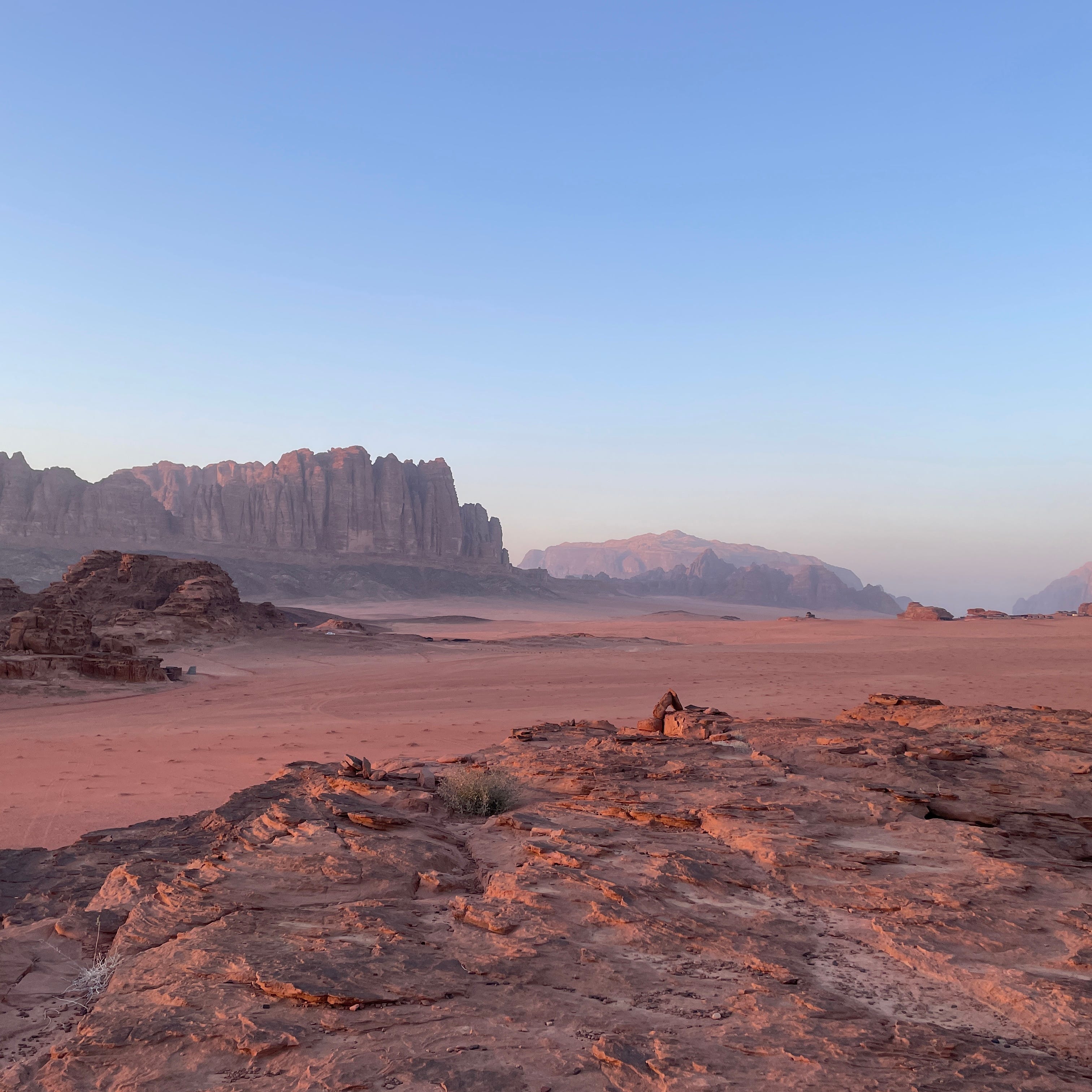
In the open ocean, far from civilization, there is a sense that you float on a living thing, that although there may not be humans near, there is life. In Wadi Rum, an open desert devoid of water, there is no feeling of life — even with the scatterings of green popping through places in the sand and the camel here or there. But there is the sense that something mystical vibrates and echoes across the sand, between and within the rock formations that rise like chunks of chocolate. It’s an energy you can plug into because of the quiet.
Would I have felt it while walking with the group, constant chatter in the air, their energy scrambling the natural frequency?
After a night of massaging the muscles from my lower back to my toes (with the lacrosse ball I keep in my suitcase) and stretching, I was able to walk without pain the next day. Thankfully, as I was about to face Petra for the first time.
Until 1812, when a curious Swiss traveler found it, the ancient city was hidden from foreigners in a landscape of mountains, canyons, and crevices. Petra was the affluent trading capital of the Nabataean empire from 400 B.C. to A.D. 106, until the Romans conquered the Nabataeans. The city then faded into obscurity as more important trade routes were established and a major earthquake destroyed the city’s sophisticated and essential water system. Today, abandoned by inhabitants, overrun by tourists, Petra has retained its grandeur.
We were assigned rooms in a nearby hotel, dropped our luggage off, and ventured, as a group, to Petra’s entrance. Our guide handed us our two-day tickets to the world wonder. I was ready to launch towards the Siq, the 1.2-kilometre canyon passageway snaking into Petra, when he told us all to wait. We would be making this trek together.
We followed the sea of tourists — a flow that seemed to move faster than the speed of our group. Our guide, as guides do, stopped frequently to share information about the Siq and city’s history — a history I planned on investigating in the museum, on my own, at my own pace. He seemed to stop when I wanted to continue and continue when I wanted to stop. Our travel styles were out of sync.
“Sandra, come on.”
“Sandra, don’t go ahead.”
“Sandra, what’s the rush?”
“Sandra, don’t you like us?”
I felt he was shaming me for my excitement, shamed for being different, singled out for not conforming, for being me. My insecurities roared. I was like a toddler in one of those harnesses parents used into the 80s, trying to hinder their child’s exploration and freedom. My mum briefly snapped my wandering younger brother into one, but it didn’t work. He would always escape from the reins.
Finally, we rounded a corner and there it was. Al Khazneh, or the Treasury, the building I’d seen in Indiana Jones and the Last Crusade. But it’s not entirely a building. The columns were hand-hewn into the sandstone to create the façade, which is just that, a façade. This exceptional piece of art masks only a tiny tomb for royalty. It’s riddled with bullet holes made by treasure seekers believing fortunes hid within a great temple.
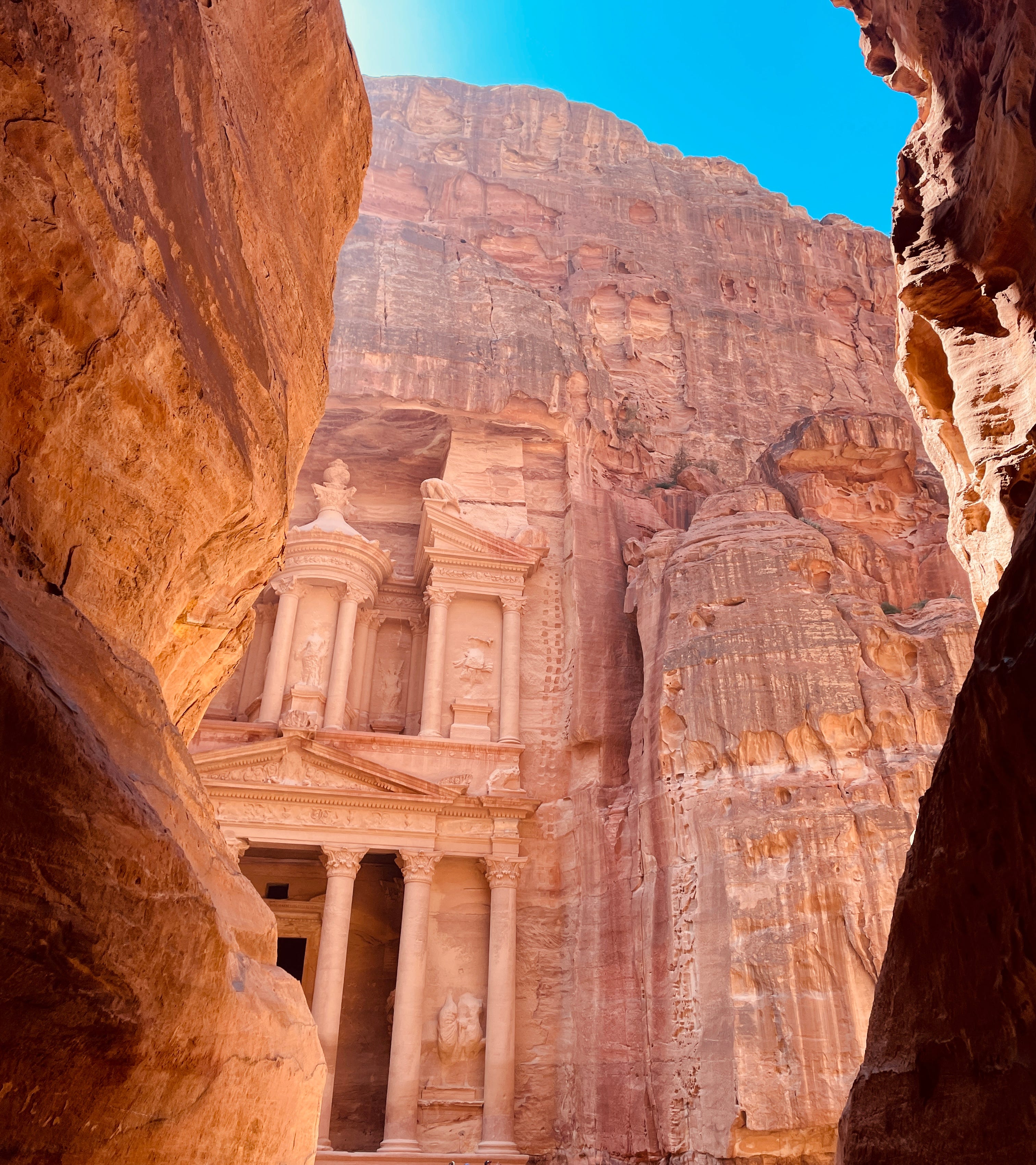
My eyes welled. The courtyard’s bustling world — crammed with tourists, guides, camels, donkeys, and merchants — vanished. It was just me and a childhood dream being realized. It turns out, I could still feel a place in the presence of people.
Escape #3
It’s not an escape if you are, in fact, set free, but I’ll still count this as such. Our guide cut the cord — we were free to explore on our own for the rest of that day and the next.
I dashed from the Treasury’s courtyard as fast as my long legs could stride without running. I needed to leave the close quarters and find openness, so I could shake off the perceived constraint. I emerged from the shadows of a rocky corridor into a sun-lit valley and found a city carved into stone.


There are several hikes you can embark on through and around the city. Some take you up steep climbs to unreal vantage points and sites for ceremonial sacrifices; others lead you to tombs dug into patterned, multi-coloured sandstone, where you duck your head or whole body inside and are further awed by preserved mosaics. The main road, the Street of Facades, travels past dwellings high in the cliff and a theatre that once sat 6,000 spectators. This turns into Colonnaded Street lined with temples. One needs more than a day and a half to explore what’s available. Not even archaeologists have explored it all — eighty-five percent of the city remains undiscovered.
I did my best to see all I could within the afternoon window, navigating the immense crowds of people doing the same. That quarter of 2023 saw 324,350 visitors — a record for Petra.
I had a plan to avoid them.
The next morning I awoke before first light to arrive at the ticket window when it opened at 6am. Our guide told us it wasn’t worth it to follow this strategy, and to go later in the morning, but I’d already learned his guidance wasn’t aligned with mine.
It was still dark when I showed my entry ticket a little late at 6:15am. There was no one immediately ahead of or behind me. This approach would be mine alone. At the tunnel-like opening of the Siq, I clicked on my flashlight, feeling like the adventurer I had come here to be. With walls 250 feet high, the Siq at night would be a claustrophobic’s nightmare. Even I, without the phobia, felt tingles in the small of my back, anticipating lost spirits or unknown creatures or shady bandits around every corner. Instead, I saw the jumpy shadows from a flashlight somewhere ahead and heard the hollow echo of low voices. The effect was eerie. I suppose, this low-grade fear is why some choose to travel in a group versus alone. But this is where I thrived. I love a ghost story.
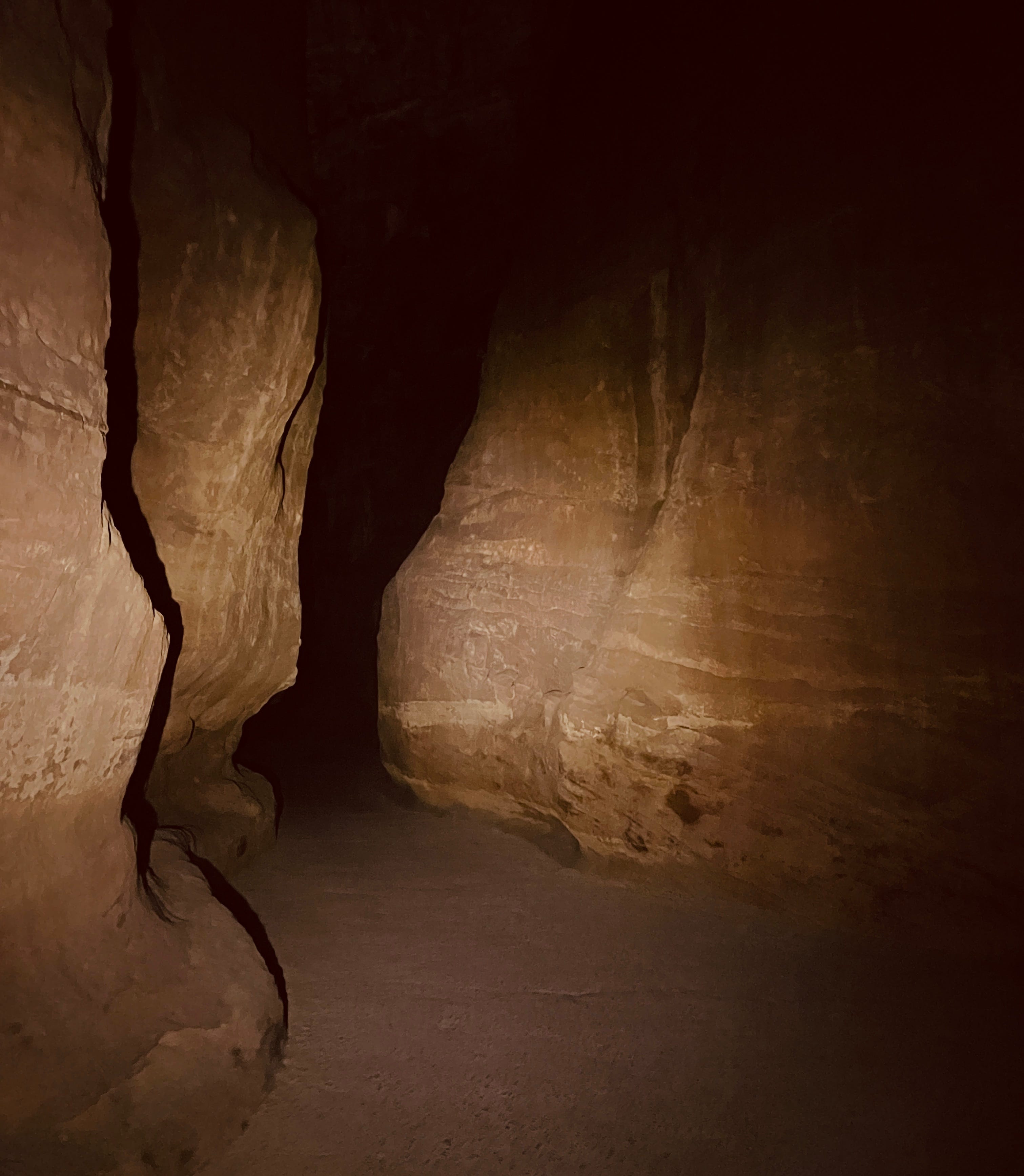
I was halfway through when a blob of white appeared in my periphery. I jumped and gasped, ready to fight and flight. A dog. Big eyes. Thin body. White coat. This was a companion I welcomed. We traveled together until a sliver of light, first sun, appeared around a crook in the passageway.
There they were, the grand columns of the Treasury, barely visible in the twilight.
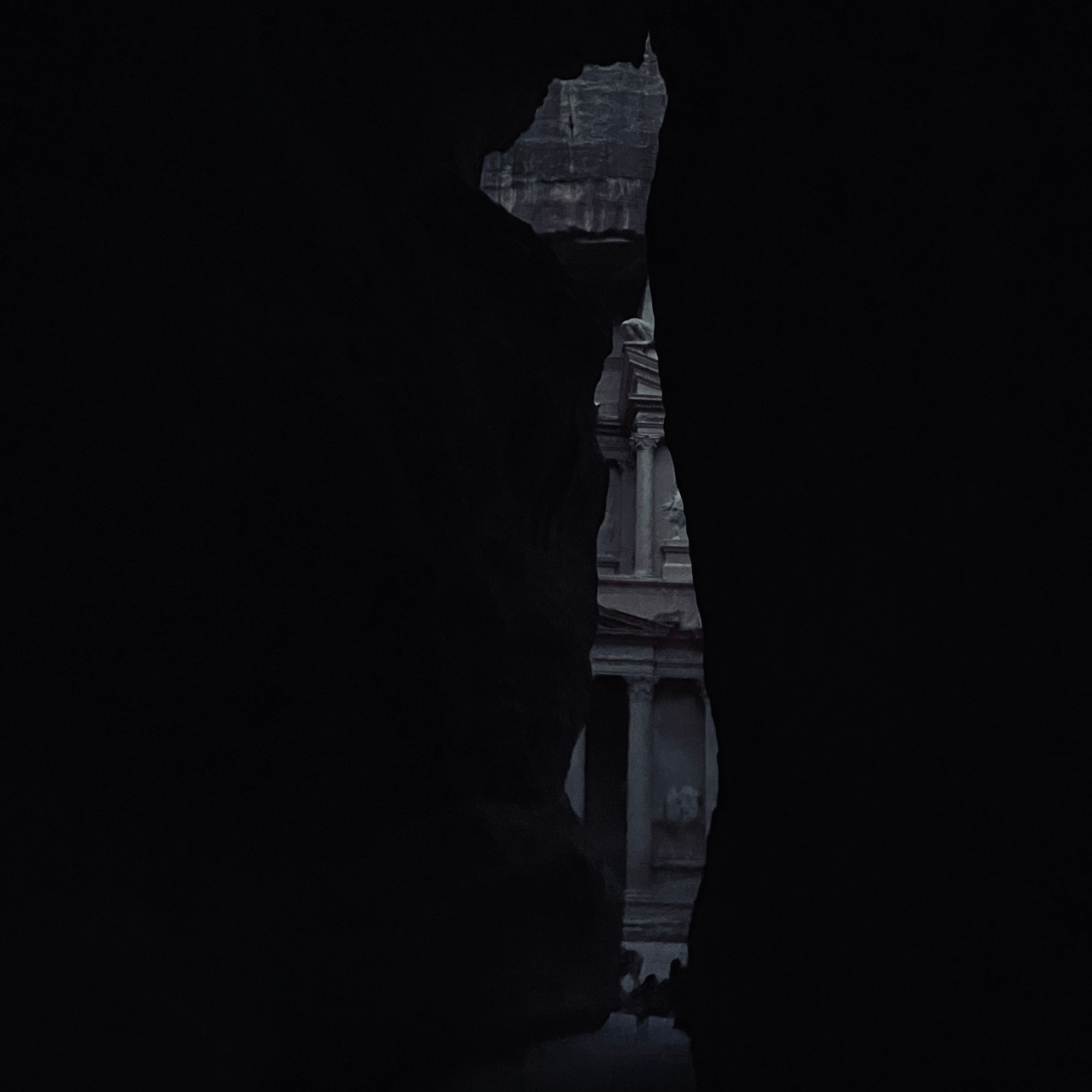
I saw only six or seven other travellers standing before it, along with some camels and their handlers. I nodded at a few travellers, an acknowledgement that we were different than the crowds. We spaced ourselves, respecting the mutual need to be alone in this special moment. And we watched the light expand and slowly bathe more and more of the wonder in sun. I had found my people.
My mission for the morning was to hike to El-Deir, or the Monastery. Another, even grander, temple accessible from a trail through the desert or via a mountain path of 850 vertical steps at the very end of Petra’s main street. My route was the latter.
The dog followed as I walked through the remains of Petra, an orange sunrise making the rose sandstone glow. There was not a soul in sight except the donkeys and other dogs wandering the grounds.
While the day before I rushed to get passed the mobs of people, today I strolled.
Just as Wadi Rum had awed me with its emptiness, the city felt bigger, fuller with no one in it. I imagined the Nabataeans popping in and out of their stone creations. A community of 30,000 — back then, when populations were smaller — must have felt like Manhattan. And here I was alone to absorb it, welding a deep connection with a place. Tears fell down my cheeks.


The dog continued to follow as I completed the first set of stairs towards the Monastery. I believed the dog’s soul was once an ancient inhabitant of Petra, and it was tasked with watching over the city’s remains — I believe the same about the cats in Roman ruins. As you do with some people, I felt as though I had known this dog in another life. Perhaps Petra was another life experience for me too.
The climb burned my thighs and calves, but I had spent another night of massaging and stretching, and I was prepared for this. On the zig-zag journey up, I passed covered market stalls, vacant cafés, and shadowy caves. But not one person. As though I were discovering this place in an empty world.


Forty minutes later, just before I was to arrive at my destination, my companion paused, stared deeply into my eyes as though saying something profoundly loving, and turned back the way we had come. His duty to protect and accompany was fulfilled. See you in the next life.
The Monastery looks similar to the Treasury, architecture etched into stone, but larger and deeper. It was originally a Nabataean tomb and then became a church in Byzantine times.
There was a couple already admiring the wonder. I later learned they had hiked in from the back trail. Again, people like me — outliers from the masses. They also told me they had rented a car and were driving around, and it was entirely safe to do so as a woman traveling alone. I hope to return and do this one day.
A café across from the Monastery was just opening, and I ordered a tea with a front-row seat of the archeological treasure. I watched as more people trickled into the plaza. I witnessed their wonder as they saw the temple for the first time, exhilarated from the climb and from the hit of awe.
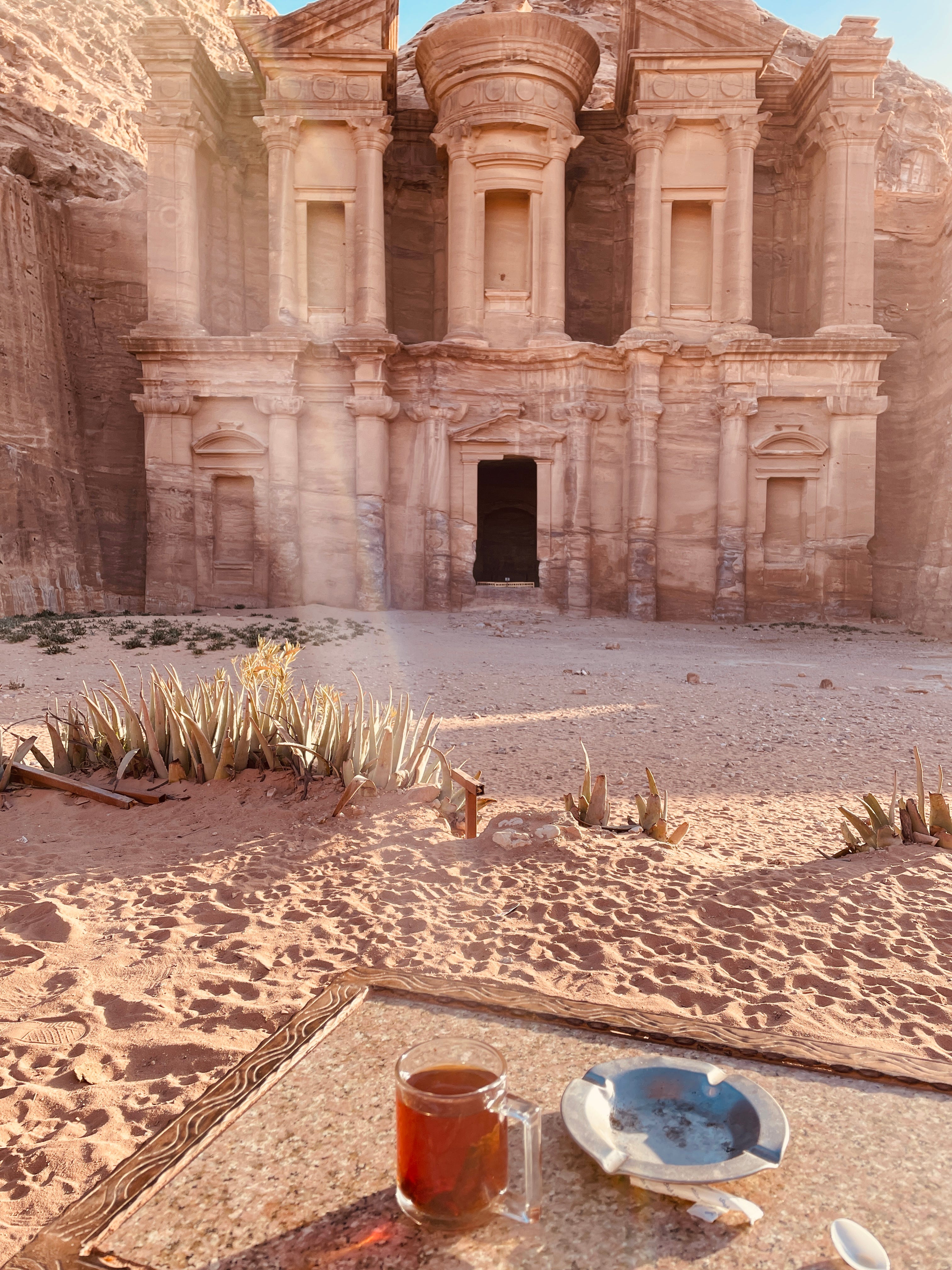
This is what I love about travel. Simply being in a place. Watching how people interact with it and with each other. Soaking in the energy, imagining what it must have been like to be here when it was first created.
Most of the time, I need to be alone to do that. You can be traveling with people you like — or even people you love — and still need and want to be alone, to have your own experiences. And that’s okay. You can also love people and be great with people, and prefer to travel alone. There is no either or.
In that moment, the shame disappeared, and I was wholly myself, my favourite travel companion.
Escape #4
My final escape was two days later. As a group, we visited the Dead Sea and Mount Nebo, and spent a night in Madaba. The last excursion was a tour of the ruins of Jerash, Jordan’s largest Roman site, complete with an arch dedicated to Hadrian, a hippodrome where chariots raced, a temple built for Zeus, a forum, two theatres, and dozens of other structures and paved roads that were remarkably still present.


I knew exactly how I needed to experience this place. On my own, at my own pace, free to touch the columns and sit in an abandoned room and breathe the ancient air, no one telling me to slow down or hurry up. I voiced my decision to the guide, and I didn’t care anymore what he or the group would think of me for striking out on my own. He resisted my decision, but I stood my ground.
Sure, I may have missed out on some commentary and historical facts, but I could look those up on the internet. I was there to discover on my terms, to feel this place.
I went on a school fieldtrip to New York City when I was in the twelfth grade. We stayed in a hotel in the middle of Times Square. And I snuck out, just eighteen, to walk the city at night alone. I marveled at the lights, the people, the energy. I hadn’t felt the magnitude of the city like this yet, not with my classmates and teachers present.
This need to explore alone has always existed. It’s not a flaw. It’s who I am.
A Note
When I sent the first newsletter to you in July, I intended to send one monthly. I have already broken my promise. But the unexpected happened in August and then in September. Two friends tragically passed away.
The first was my dear friend, fellow writer and travel lover, Joy Pecknold. Here’s an article she wrote for the Kiwi Collection on Paris. You can also order a book of her poems.
My friend Annie Frind also passed away; ours was a friendship that started in high school and continued well into adulthood. She was an incredibly talented artist, a mum, and a travel lover, too.
Show and tell your friends and family how much you love them — there’s no guarantee as to how much time we have here.